

A biosphere reserve is a site designated under UNESCO’s Man and the Biosphere (MAB) Programme.
Biosphere Reserve
What is a Biosphere Reserve?
A Biosphere Reserve (BR) is an area designated for the conservation of biodiversity while promoting sustainable development and harmonious interaction between people and nature.
Biosphere Reserves may include:
- Terrestrial ecosystems
- Marine ecosystems
- Coastal ecosystems
- Forests
- Mountains
- Wetlands
- Islands
They function as “learning places for sustainable development” and as living laboratories for studying the interaction between ecological and socio-economic systems.
Key objectives
- Conservation of biodiversity.
- Protection of ecosystems and landscapes.
- Promotion of scientific research and monitoring.
- Sustainable use of natural resources.
- Promotion of local and traditional knowledge.
- Development of sustainable livelihoods.
- Reduction of pressure on ecologically sensitive areas.
- Promotion of environmental education.
2. UNESCO Man and the Biosphere Programme
The Man and the Biosphere (MAB) Programme is a UNESCO programme under which Biosphere Reserves are internationally recognized.
The World Network of Biosphere Reserves (WNBR) consists of biosphere reserves recognized under the UNESCO MAB Programme.
Important points
- Biosphere Reserves are nominated by national governments.
- They remain under the sovereign jurisdiction of the concerned country/state.
- UNESCO recognition is different from the initial notification of a Biosphere Reserve by India.
- The MAB Programme seeks to combine:
- biodiversity conservation,
- scientific research,
- environmental education,
- sustainable development, and
- community welfare.
MAB-ICC
The main governing body of the MAB Programme is the International Coordinating Council (MAB-ICC).
- It is also known as the MAB Council.
- It consists of 34 Member States.
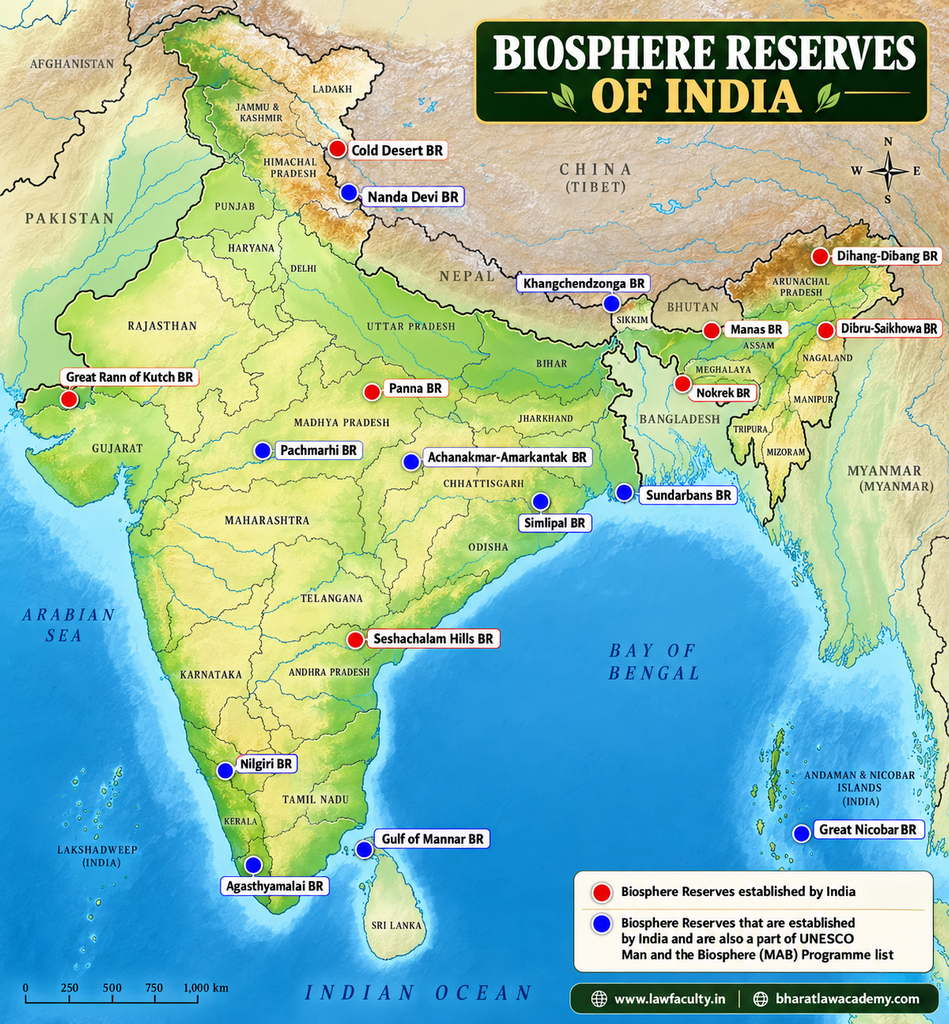
3. Biosphere Reserves in India
- 18 Biosphere Reserves have been notified in India.
- They cover approximately 91,425 sq. km.
- 13 Biosphere Reserves are recognized by UNESCO under the World Network of Biosphere Reserves.
- They extend across India’s mountains, forests, coasts and islands.
Latest important update
The Cold Desert Biosphere Reserve of Himachal Pradesh was included in UNESCO’s World Network of Biosphere Reserves in September 2025.
List of Biosphere Reserves of India
| No. | Biosphere Reserve | Year | State/UT | Area (km²) |
| 1 | Nilgiri | 1986 | Tamil Nadu, Kerala, Karnataka | 5,520 |
| 2 | Nanda Devi | 1988 | Uttarakhand | 5,860 |
| 3 | Nokrek | 1988 | Meghalaya | 820 |
| 4 | Gulf of Mannar | 1989 | Tamil Nadu | 10,500 |
| 5 | Sundarbans | 1989 | West Bengal | 9,630 |
| 6 | Manas | 1989 | Assam | 2,837 |
| 7 | Great Nicobar | 1989 | Andaman & Nicobar Islands | 885 |
| 8 | Similipal/Simlipal | 1994 | Odisha | 4,374 |
| 9 | Dibru-Saikhowa | 1997 | Assam | 765 |
| 10 | Dihang-Dibang | 1998 | Arunachal Pradesh | 5,112 |
| 11 | Pachmarhi | 1999 | Madhya Pradesh | 4,982 |
| 12 | Khangchendzonga | 2000 | Sikkim | 2,620 |
| 13 | Agasthyamalai | 2001 | Kerala, Tamil Nadu | 3,500 |
| 14 | Achanakmar-Amarkantak | 2005 | Madhya Pradesh, Chhattisgarh | 3,835 |
| 15 | Great Rann of Kutch | 2008 | Gujarat | 12,454 |
| 16 | Cold Desert | 2009 | Himachal Pradesh | 7,770 |
| 17 | Seshachalam Hills | 2010 | Andhra Pradesh | 4,755 |
| 18 | Panna | 2011 | Madhya Pradesh | 543 |
Biosphere Reserves – Reserve-wise Important Facts
Nilgiri Biosphere Reserve
Year: 1986
States: Tamil Nadu, Kerala and Karnataka
Area: 5,520 km²
Important facts
- India’s first Biosphere Reserve.
- The Nilgiris are associated with the Neelakurinji flower, which blossoms once in approximately 12 years.
- Important protected areas associated with the Nilgiri landscape include:
- Mudumalai
- Mukurthi
- Nagarhole
- Bandipur
- Silent Valley
- Aralam
- Wayanad
- Sathyamangalam.
Important fauna
- Lion-tailed Macaque
- Nilgiri Tahr
- Malabar Giant Squirrel
- Nilgiri Langur
Exam keyword: Western Ghats + Neelakurinji + Nilgiri Tahr.
Nanda Devi Biosphere Reserve
Year: 1988
State: Uttarakhand
Area: 5,860 km²
Important facts
Nanda Devi Biosphere Reserve includes:
- Nanda Devi National Park
- Valley of Flowers National Park
Major fauna
- Snow Leopard
- Musk Deer
- Bharal/Blue Sheep
Exam keyword: Nanda Devi + Valley of Flowers + Snow Leopard.
Nokrek Biosphere Reserve
Year: 1988
State: Meghalaya
Area: 820 km²
Important facts
- Nokrek (1,412 m) is the highest peak of the Garo Hills.
- Vegetation includes:
- evergreen,
- semi-evergreen, and
- deciduous forests.
Major fauna
- Red Panda
- Hoolock Gibbon
- Red Giant Flying Squirrel
Exam keyword: Garo Hills + Meghalaya + Red Panda.
Gulf of Mannar Biosphere Reserve
Year: 1989
State: Tamil Nadu
Area: 10,500 km²
Important facts
- Located between the southeastern tip of India and Sri Lanka.
- Associated with the Coromandel Coast.
- Contains:
- islands,
- estuaries,
- seagrass,
- coral reefs,
- salt marshes and
- mangroves.
- Ram Setu/Adam’s Bridge separates the Gulf of Mannar from Palk Bay.
Major fauna
- Dugong
- Olive Ridley Turtle
Exam keyword: Marine Biosphere Reserve + Dugong + Coral reefs.
Sundarbans Biosphere Reserve
Year: 1989
State: West Bengal
Area: 9,630 km²
Important facts
- Located in the Ganga Delta.
- Borders Bangladesh.
- Famous for the Royal Bengal Tiger.
- Important protected areas associated with the reserve include:
- Sundarbans National Park
- Sajnekhali Wildlife Sanctuary
- Lothian Wildlife Sanctuary
- Haliday Wildlife Sanctuary.
Exam keyword: Mangrove ecosystem + Ganga Delta + Royal Bengal Tiger.
Manas Biosphere Reserve
Year: 1989
State: Assam
Area: 2,837 km²
Important facts
- Associated with Manas National Park.
- Contiguous with Royal Manas National Park of Bhutan.
- Famous for the Wild Water Buffalo.
Important fauna
- Assam Roofed Turtle
- Hispid Hare
- Golden Langur
- Pygmy Hog
- Wild Water Buffalo
- Bengal Florican
Exam keyword: Assam + Bhutan + Wild Water Buffalo + Golden Langur.
Great Nicobar Biosphere Reserve
Year: 1989
UT: Andaman & Nicobar Islands
Area: 885 km²
Important facts
Great Nicobar Biosphere Reserve includes:
- Campbell Bay National Park
- Galathea National Park
Vegetation is dominated by tropical wet evergreen forests.
Major fauna
- Dugong
- Saltwater Crocodile
Exam keyword: Great Nicobar + Campbell Bay + Galathea.
Similipal Biosphere Reserve
Year: 1994
State: Odisha
Area: 4,374 km²
Important facts
It is associated with the Mayurbhanj Elephant Reserve, comprising:
- Similipal Tiger Reserve
- Hadgarh Wildlife Sanctuary
- Kuldiha Wildlife Sanctuary.
Important tribal communities include:
- Erenga
- Kharia
- Mankirdia
- Ho
- Gonda
- Munda.
Major fauna
- Royal Bengal Tiger
- Wild Elephant
- Gaur
- Chausingha
Pachmarhi Biosphere Reserve
Year: 1999
State: Madhya Pradesh
Area: 4,982 km²
Important facts
Pachmarhi Biosphere Reserve includes:
- Satpura National Park
- Bori Wildlife Sanctuary
- Pachmarhi Wildlife Sanctuary
It lies in the Satpura Range.
Highest point
Dhoopgarh – 1,352 m
Important tribe
Gond
Major fauna
- Tiger
- Gaur
- Indian Giant Flying Squirrel
Khangchendzonga Biosphere Reserve
Year: 2000
State: Sikkim
Area: 2,620 km²
Important facts
- Located in a major Himalayan biodiversity region.
- Includes Mount Kanchenjunga, the world’s third-highest mountain.
- Elevation ranges from approximately 1,220 m to 8,586 m.
- Khangchendzonga National Park forms the core area.
- Khangchendzonga National Park was inscribed as India’s first Mixed World Heritage Site.
Major fauna
- Red Panda
- Snow Leopard
- Musk Deer
- Great Tibetan Sheep/Argali
Exam keyword: Sikkim + Kanchenjunga + Mixed World Heritage Site.
Agasthyamalai Biosphere Reserve
Year: 2001
States: Kerala and Tamil Nadu
Area: 3,500 km²
Includes
- Shendurney Wildlife Sanctuary
- Peppara Wildlife Sanctuary
- Neyyar Wildlife Sanctuary
- Kalakad-Mundanthurai Tiger Reserve
It is also associated with the Kani tribal community.
Major fauna
Nilgiri Tahr
Important exam question
Agasthyamalai Biosphere Reserve includes which of the following?
The correct combination given in the source is:
Neyyar, Peppara and Shendurney Wildlife Sanctuaries and Kalakad-Mundanthurai Tiger Reserve.
Achanakmar-Amarkantak Biosphere Reserve
Year: 2005
States: Madhya Pradesh and Chhattisgarh
Area: 3,835 km²
Important facts
- Extends across Madhya Pradesh and Chhattisgarh.
- Includes the Maikal Hills along with parts of the eastern Vindhyas and Satpuras.
- Vegetation:
- moist deciduous forests
- dry deciduous forests.
Major fauna
- Four-horned Antelope/Chausingha
- Indian Wild Dog/Dhole
Exam keyword: MP + Chhattisgarh + Maikal Hills.
Great Rann of Kutch Biosphere Reserve
Year: 2008
State: Gujarat
Area: 12,454 km²
Important facts
- The Great Rann of Kutch is a salt marsh in the Thar Desert.
- Associated areas include:
- Kachchh Desert Sanctuary
- Wild Ass Sanctuary
- Narayan Sarovar Sanctuary
- Kutch Bustard Sanctuary
- Banni Grasslands Reserve.
Major fauna
- Great Indian Bustard
- Indian Wild Ass
Exam keyword: Gujarat + Salt Marsh + Indian Wild Ass + Great Indian Bustard.
Cold Desert Biosphere Reserve
Year: 2009
State: Himachal Pradesh
Area: 7,770 km²
Important areas
- Pin Valley National Park
- Chandratal
- Sarchu
- Kibber Wildlife Sanctuary.
Major fauna
- Snow Leopard
- Himalayan Ibex
Current-affairs importance
The Cold Desert Biosphere Reserve was included in UNESCO’s World Network of Biosphere Reserves in September 2025.
Exam keyword: Himachal Pradesh + Trans-Himalayan ecosystem + Snow Leopard + 2025 UNESCO recognition.
Seshachalam Hills Biosphere Reserve
Year: 2010
State: Andhra Pradesh
Area: 4,755 km²
Important facts
- Located in the Eastern Ghats of southern Andhra Pradesh.
- Tirupati and Sri Venkateswara National Park are associated with the Seshachalam Hills.
- Famous for Red Sanders, a rare and economically important plant.
- Golden Gecko is associated with the Tirumala Hills.
Exam keyword: Andhra Pradesh + Eastern Ghats + Red Sanders + Tirupati.
Panna Biosphere Reserve
Year: 2011
State: Madhya Pradesh
Area: 543 km²
Important facts
The source identifies:
Panna Biosphere Reserve = Panna Tiger Reserve
Major fauna
- Tiger
- Chital
- Chinkara
- Sambar
Exam keyword: Madhya Pradesh + Tiger + smallest area among the listed reserves.
Important Flora and Fauna – One-Liner Revision
| Biosphere Reserve | Important Species |
| Nilgiri | Lion-tailed Macaque, Nilgiri Tahr |
| Nanda Devi | Snow Leopard, Musk Deer, Bharal |
| Nokrek | Red Panda, Hoolock Gibbon |
| Gulf of Mannar | Dugong, Olive Ridley |
| Sundarbans | Royal Bengal Tiger |
| Manas | Wild Water Buffalo, Golden Langur, Pygmy Hog |
| Great Nicobar | Dugong, Saltwater Crocodile |
| Similipal | Tiger, Elephant, Gaur, Chausingha |
| Pachmarhi | Tiger, Gaur |
| Khangchendzonga | Red Panda, Snow Leopard |
| Agasthyamalai | Nilgiri Tahr |
| Achanakmar-Amarkantak | Four-horned Antelope, Dhole |
| Great Rann of Kutch | Great Indian Bustard, Indian Wild Ass |
| Cold Desert | Snow Leopard, Himalayan Ibex |
| Seshachalam Hills | Red Sanders, Golden Gecko |
| Panna | Tiger, Chital, Chinkara, Sambar |
| Dibru-Saikhowa | Bengal Tiger, Clouded Leopard, Gangetic Dolphin |
| Dihang-Dibang | Takin, Red Panda |
Important Government Initiatives Linked with Biosphere Reserves
India’s Biosphere Reserve programme works alongside several conservation programmes.
Project Tiger
- Started in 1973.
- Focuses on tiger conservation and habitat protection.
- Completed 50 years in 2023.
Project Elephant
Focuses on:
- elephant habitat protection,
- mitigation of human-elephant conflict,
- conservation of elephant populations, and
- welfare of captive elephants.
Integrated Development of Wildlife Habitats
A Centrally Sponsored Scheme providing financial and technical assistance to States and Union Territories for wildlife conservation.
National Biodiversity Action Plan
Works within India’s biodiversity conservation framework and is connected with regulation of biological resources and associated traditional knowledge.
Eco-Sensitive Zones
Act as a transition or “shock absorber” around protected areas, helping regulate activities around ecologically sensitive ecosystems.
Green India Mission
Focuses on:
- restoration and enhancement of forest cover,
- biodiversity,
- water resources,
- ecosystems such as mangroves and wetlands,
- climate-change mitigation.
Funding Pattern for Biosphere Reserve Conservation
The Biosphere Reserve Division of the Ministry of Environment, Forest and Climate Change (MoEFCC) administers a Centrally Sponsored Scheme for biodiversity conservation.
Cost-sharing pattern
| Region | Central : State |
| General States | 60 : 40 |
| North-Eastern & Himalayan States | 90 : 10 |
The scheme also emphasizes alternative livelihoods, eco-development and sustainable resource management for communities living in and around Biosphere Reserves
[…] Biosphere Reserves of India: Complete List, Map, States, Year, Area, UNESCO Status & Important F… Search […]